What is SEO? A Complete Guide to Optimize Your Contents
Author- Kuntal Barik
Introduction
Have you ever become curious about why some websites always rank at the top of the google while others remain hidden or do not rank well on serp? The answer lies in your own online marketing strategy, which is known as SEO (Search Engine Optimisation). Whether you run a business or create a blog post for your website, SEO is the main factor which can help you to gain traffic organically and improve your website’s ranking.
Everyday billions of people searches something on search engines like Google, Bing and Yahoo. Users search for getting services, buying products, or getting information. If your website is seo friendly, well-optimised, and focuses on the key content according to users serach behaviour, then it will be cost-effective and drive traffic organically and help your business grow in the long term digital era.
What is SEO?
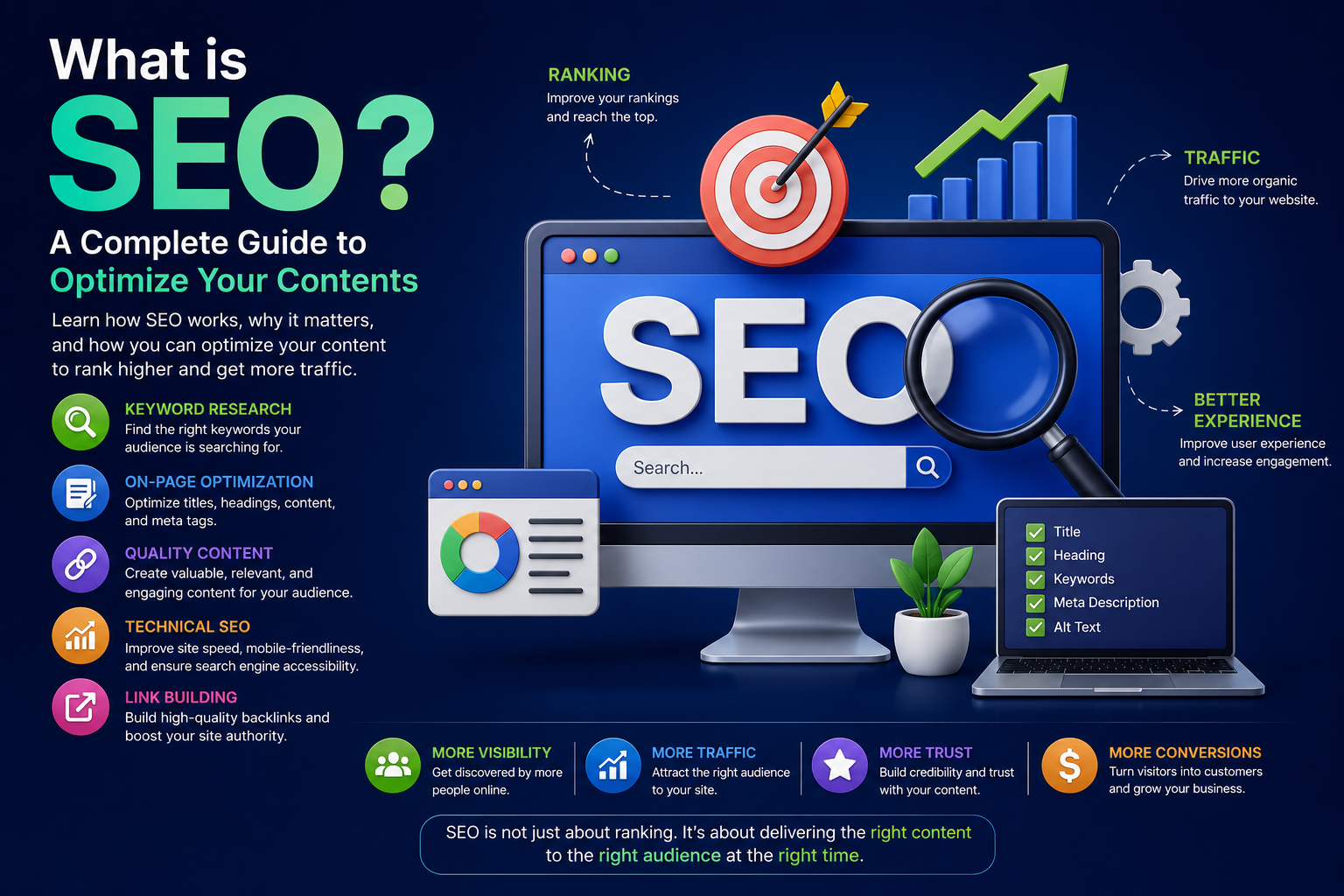
SEO (Search Engine Optimization) is a set of practice to optimize your website’s pages or contents and rank them organically in search engine results page. We can use different types of SEO tactics to rank our websites and its content.
The main objective is to help search engines find and understand your content better so that it gives better results according to users’ search queries.
It involves improving various aspects of a website, including keyword use, loading speed, user experience, site structure, and mobile friendliness, as well as quality content. A well optimised and seo friendly website not only rank hifger on serp but at the same time it also improves the experience for the visitors.
Search engines use an algorithm to navigate and determine which pages of a website should rank higher. Just doing SEO can help connect you with the people who are actively looking for it.
Why is SEO Important?
SEO is one of the most crucial parts of digital marketing strategies. It delivers long-term results. It is important cause it increases organic traffic and improves your site’s ranking on serp. Here are 5 reasons why SEO matters.
1.Increases Organic Traffic
When you implement seo tactics, it automatically improves your website visibility and bring orgaick traffic. It often attracts users to what they are looking for. When your site ranks higher on the search engines, it becomes more visible to the visitors according to their relevant search queries or the information they are searching for. Unlike paid advertising, organic traffic can help to grow your business without spending a huge amount of money. As your ranking improves, your website becomes easily accessible for the more qualified visitors who have started to become interested in your content, leading to better conversion rates and long-term business growth.
2. Improves Visibility
Online visibility often determines how easily people can discover your website on the search engine results page. By practising SEO, you can improve your online visibility and optimise your content according to users’ relevance and search intent. When a users search something on the search engines, they generally visit the top 1-10 ranking websites. When your website appears on the first page pg google, it not only increases your brand reputation but also creates a valuable authority. So when someone is looking for information, products, or services, your website has a greater chance of reaching your target audience.
3.Highly Cost-Effective
The main feature is that it is shighly cost effective. You don’t have to pay any advertising fees, which you do for PPC campaigns. It mainly focuses on improving your website’s visibility by driving organic search results. Although it requires time and effort to optimise your website’s content according to SEO guidelines. But if you want to gain long-term benefits, then it will surely help through initial investment. A well-optimised site can generate continuous leads, traffic and conversions for months or even years. This makes SEO an outstanding choice for business owners.
4.Enhances User Experience
It also prioritises the websites that offer an outstanding user experience. SEO and website audit tools, such as RankMath, WooRank, SemRush, SERanking, and SEO Optimer, tell business owners about their website and suggest recommendations that need to be upgraded. At the same time, it encourages website owners to improve page speed, mobile friendliness, navigation, readability and overall website usability. A well-optimised and good website that follows SEO guidelines allows visitors to quickly find the information they want, saving time and increasing engagement rate over time. Fast page loading speed and good navigation significantly reduce the bounce rates and create interest among the users to explore the additional content. By focusing on user experience, website owners can easily improve the impression of their brand.
5.Improves Conversion and Sales
SEO brings targeted visitors to your website. It attracts users who are already searching for the services or information you offer. When these users find relevant content, services or navigation, they clearly make a call to action such as visiting the page, making a purchase, signing up for a newsletter or submitting an inquiry. Optimising the website according to SEO, improving the landing pages and creating good quality content increases the sales and conversion rates. As your website brings more traffic, it generally improves your business goals significantly over time.
6.Offer Long-Term Results Without a Paid Advertising Strategy
When you aim for ppc or paid advertising, you spend your budget on each click, and when your budget runs out, it stops bringing traffic and conversion. On the other hand, SEO continues to deliver results long after your content is published. A well-optimised page can bring visitors for months or even years without making major changes. Although it requires time and efforts but, once you gain the strategy, your website generates revenue by driving organic traffic and leads without paying for every click.
Types of SEO
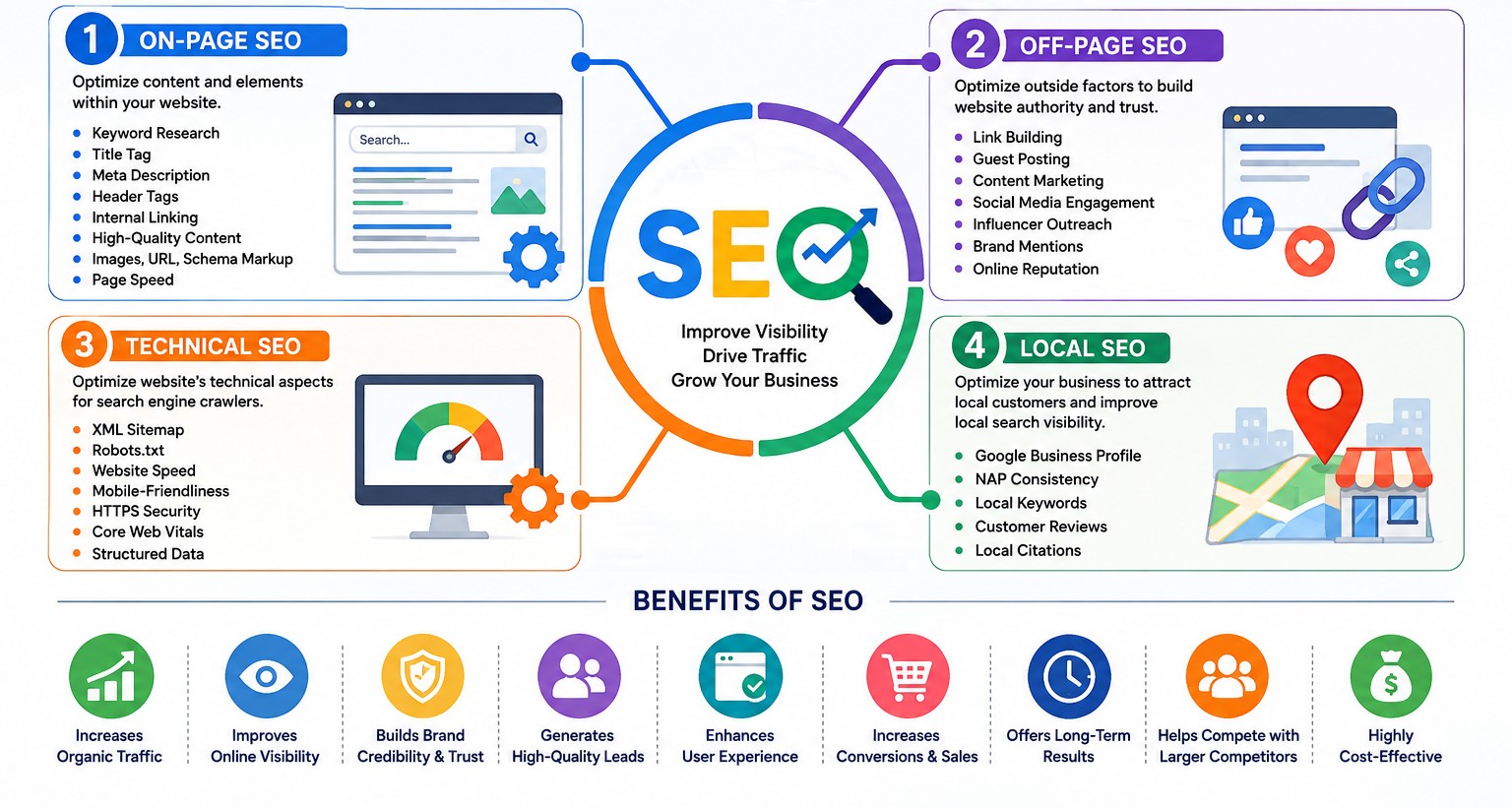
There are mainly four major types of SEO. These are-
On Page SEO
Important On-Page SEO Elements
Title Tag
The title tag is one of the most important and strongest on-page SEO factors. It mainly includes your primary keyword and clearly describes the page. A good title tag should be within 45-60 characters or up to 600 pixels.
Example- What is SEO? A Complete Guide to Optimise Your Contents
Meta Description
A meta description is a short text summary of the webpage’s content that appears generally beneath the title tag. A well-written meta description increases click-through rates. It lengths between 70 to 160 characters.
Example- SEO is the practice or strategic methods of creating high-quality and relevant content that improves organic traffic to your website.
Internal Linking
Internal linking connects one page of your website to another page. It also help new published pages to give some boost, cause new published pages generally bring low traffic, so it allows search engines to discover additional pages.
Header Tags
Using H1, H2, H3 and H4 in your content not only helps search engines understand your content properly, but at the same time it increases engagement among the users.
URL Structure
Your webpage’s URL should be short, descriptive, keyword-rich and clean.
Example- https://articlespost.online/how-to-do-keyword-research-for-beginners-in-2026/
Schema Markup
Schema markup helps search engine bots understand your content more effectively. It improves your appearance on the search engine results page through rich snippets such as FAQs and reviews.
Off-Page SEO
Off-Page SEO is a strategy where we optimise our content outside the website. These activities improve on building a trustworthy appearance on the internet.
Important Off-Page SEO Strategies
Link Building
Link Building is one of the strongest ranking factors in off page seo strategy. Backlinks have great values and they can bring relevant traffic to your website. If you create relevant and high-quality backlinks from good, authoritative websites, it will improve your visitor count.
Guest Posting
Writing blogs or articles on reputable websites can help you to gain backlinks. It will also establish your domain authority.
Social Media Engagement
Sharing valuable content on social media platforms can increase traffic, visibility and engagement, which will crease a opportunity to earn backlinks.
Influencer Outreach
Collaborating with influencers or industry experts improves your audience visibility while increasing your website’s traffic.
Brand Mentions
If your brand is mentioned on a good, reputable website, the search engine algorithm detects it as a reputable authority.
Content Marketing
Creating engaging, valuable and infographic content helps people to spend time on your website.
Technical SEO
Technical SEO mainly indicates optimising the website’s backend structure so that search engine bots can index, crawl, and understand your website.
Without the technical SEO tactics, even high-quality content may struggle to rank on the SERP.
Important Technical SEO Elements
Website Speed
A fast-loading website create better user experience and reduces the bounce rate. You can improve your website’s speed by following these methods-
- Minimising CSS and JavaScript
- Compressing images
- Reducing HTTP request
- Choosing quality hosting
- Enabling browser caching
Core Web Vitals
Core web vitals are a set of metrics created by Google to measure your website’s speed and responsiveness, including LCP, INP and CLS.
Optimising these metrics can improve the ranking and users’ engagement.
Canonical Tags
Canonical tags prevent duplicate content issues and tell search engine bots which version of a page should be indexed.
XML Sitemap
An XML sitemap is a roadmap of your website that tells search engines to crawl, find and index your content efficiently.
HTTPS Security
An HTTPS website is far more secure than an HTTP website. Google also preferred HTTPS to HTTP.
Local SEO
Local SEO is a process to improve a business’s visibility in a local area.
When a user searches or types something like that-
- Best digital marketing agency near me
- Best shoe store near me
- Dentist in Kolkata
- Best restaurant near me
Google displays local business listings on its SERP.
Benefits of Local SEO
There are many benefits of using local SEO. These are
- Improves local visibility
- Drives more local traffic
- Improves online reputation
- Build customers’ trust
- Increses website’s traffic
Mistakes to Avoid in SEO
Baginners often struggle and unknowingly mistake the SEO guidelines which affect the ranking. These are the common mistakes that a beginner should avoid in SEO practice-
- Publishing thin and duplicate content
- Keyword stuffing
- Broken internal links
- Not updating old content
- Not doing keyword research
- Low-quality backlinks
- Ignoring the users’ intent
Best SEO practices
If you want to achieve berst seo strategy, then you will have to follow these steps-
- Before writing the content, always do keyword research.
- Use Google Keyword Planner or SemRush
- Whenever you publish a new page, create internal linking so that it will give a boost to the new page.
- Update your old content regularly.
- Build high-quality backlinks.
- Use proper headings for your content
- Optimise on page, off page and technical SEO
- Optimise your website’s title and meta description.
- Improve core web vitals
- Optime images.
Conclusion
SEO is one of the most important techniques in the digital marketing field. With the understanding of SEO principles, you can improve your website’s ranking, visibility, clicks, engagement and user experience.
However, SEO is constantly evolving, and Google is constantly releasing new updates. If you are a beginner, blogger, business owner or content creator and want to grow your business digitally, then spending time or knowing the principles of SEO can lead to grow your business in the long term.
0 Comments